

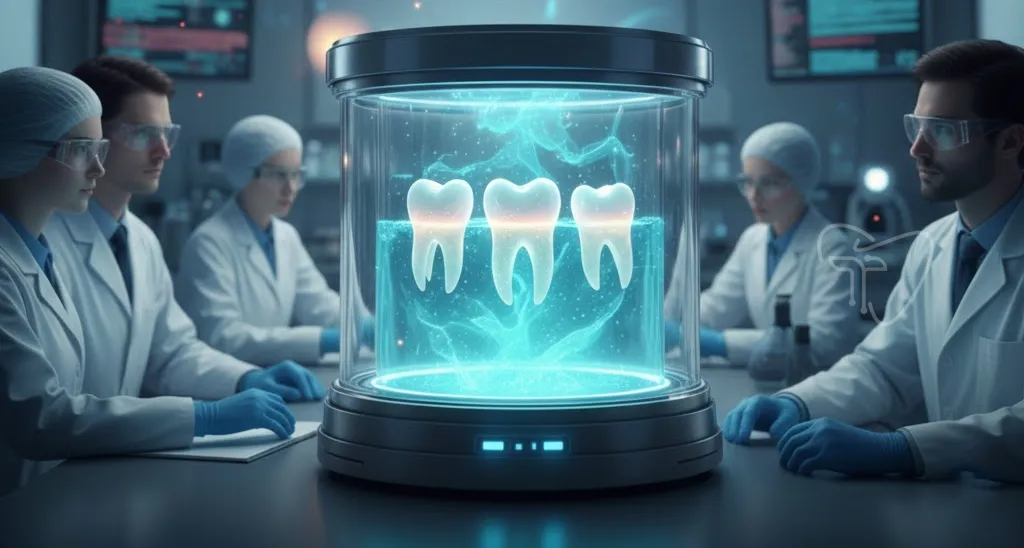
A Deep Dive into the Future of Dentistry
Introduction: The Dawn of Regenerative Dentistry
What if losing a tooth didn’t mean you had to settle for a metal implant or a denture — but instead, your body could regrow a brand-new, fully functional natural tooth grown from your own cells? As of 2025, that possibility is inching closer to reality. Researchers at King’s College London (KCL), in collaboration with Imperial College London, have announced a breakthrough: they have successfully created lab-grown human tooth-like structures, using biomaterials that mimic the natural developmental environment for teeth.
This milestone promises a shift from conventional restorative dentistry — fillings, crowns, implants — toward regenerative dentistry, where lost or damaged teeth are biologically replaced, not artificially reconstructed.
The Science behind the Breakthrough
What did the scientists do exactly?
- The research team developed a special biomaterial “scaffold” — a gel-like matrix — that mimics the natural environment of a developing tooth. This scaffolding allows dental cells to properly “communicate,” sending the right signals to one another to start tooth formation.
- In past experiments, similar scaffolds (collagen-based) were tried, but they failed because cells couldn’t coordinate effectively. The new material overcomes that by releasing developmental cues gradually over time, more closely imitating how tooth formation happens in a real body.
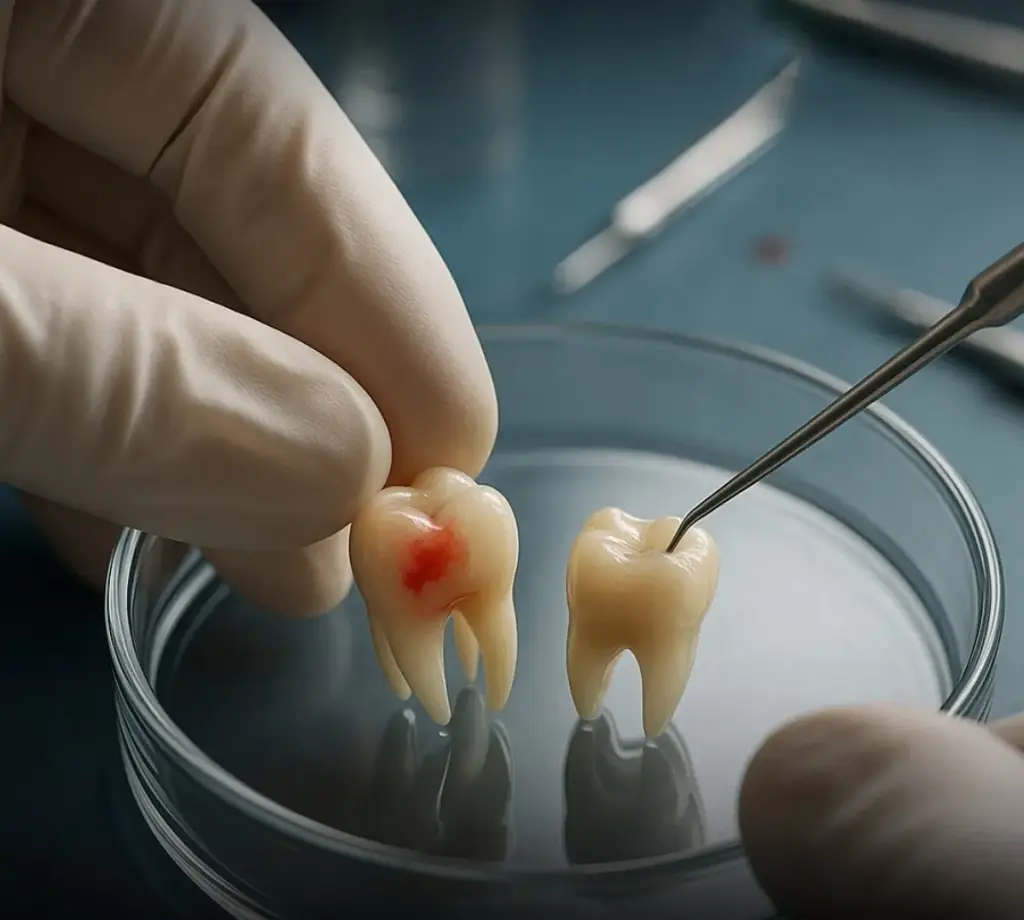
- Using this method, scientists were able to grow “tooth-like structures” in vitro — meaning outside the body, in laboratory conditions.
Why this matters
- Conventional treatments — fillings, crowns, implants — are essentially artificial patches. Fillings may weaken remaining tooth structure; implants require surgery, a healthy jawbone, and still do not fully replicate a natural tooth’s biological behavior.
- A lab-grown tooth derived from a patient’s own cells could theoretically integrate naturally with the jawbone, respond biologically over time, and even self-repair to some extent, much like a real tooth.
What This Means for Dentists around the World — A New Frontier
For dental professionals — from general dentists to prosthodontists, oral surgeons to researchers — the lab-grown tooth breakthrough signals a paradigm shift. Here’s what could change:
- From prosthetics to biology: Instead of relying mostly on artificial materials (metals, ceramics, resins), future treatments may harness a patient’s own biology.
- Personalized dentistry: Because lab-grown teeth originate from a patient’s own cells, treatments could be more individualized, reducing risk of rejection and improving long-term outcomes.
- Less invasive procedures: Traditional implants require surgery, bone grafts, and healing time; regenerated teeth may offer a less invasive alternative (depending on technique — e.g. direct cell transplantation vs full-tooth implant).
- Better long-term outcomes: Natural teeth adapt, respond to physiological changes, and—potentially—self-repair to some extent. That could mean fewer complications, fewer replacements, and improved oral health.
- New responsibilities for dental professionals: Dentists might need training in regenerative techniques, stem-cell handling, bio-engineering, and emerging protocols — a shift from mechanical prosthetic work toward biological restoration.
For a global blog like DENTrends, this marks a historic turning point — a perfect time to start covering regenerative dentistry, future-oriented DENTech, and what it might mean for dentists and patients worldwide.
Outlook: What to Watch in Coming Years
- Researchers will need to demonstrate that lab-grown teeth can survive and function long-term in living jaws: with root development, bone integration, biting force, resilience against decay, etc.
- Clinical trials (either of cell-transplantation approaches or full-tooth implants) — will likely begin only after extensive safety, biological, and regulatory validation.
- Manufacturing and standardization — producing scaffolds, ensuring sterility, scaling up from lab to clinic — will be critical.
- Ethical and regulatory issues around stem cells, patient consent, cost, accessibility — especially for low- and middle-income countries — must be considered.
- Until then — conventional dentistry (fillings, crowns, implants) will remain essential. But as a dentist, staying updated on DENTech developments will give you an edge.
Conclusion
The 2025 breakthrough by King’s College London and Imperial College London represents a landmark in dental research — the first time human-cell–derived tooth-like structures have been grown in the lab with a biomaterial scaffold designed to mimic natural tooth development.
While we are not yet at the point where lab-grown teeth can replace artificial implants in daily practice, this research opens the door to a future where dentistry becomes truly regenerative — biologically rooted, patient-specific, and far more integrated with natural physiology than ever before.
For the global community of dentists — and for DENTrends readers — this is more than a news item: it’s the beginning of a new chapter in oral health. lab-grown human teeth, tooth regeneration research, regenerative dentistry 2025, King’s College London tooth study, bioengineered teeth, future of dental implants, stem-cell dentistry, lab-grown teeth vs implants, dental research news, tooth regeneration technology